


The IWG perspective
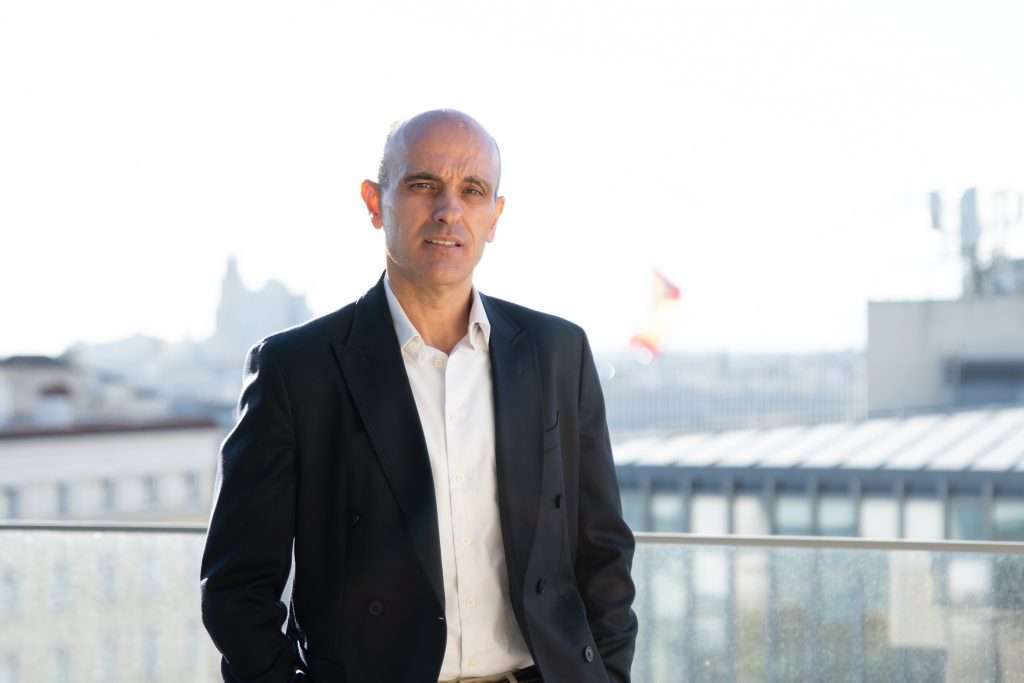
Interview with Philippe Jiménez, General Manager of IWG in Spain. Written by María Mañoso, marketing specialist at ISEO.
Philippe Jimenez has a solid academic background. He holds a Bachelor’s degree in Economics from the Sorbonne University in Paris and a Master’s degree in International Negotiation from a Business School. In the work environment, Philippe has an extensive experience of 30 years working at Regus and later at group level at IWG, where he has developed his entire professional career.
In this interview, the General Manager in Spain, shares his vision on the evolution and challenges of the coworking industry, from his experience in transforming IWG from a small company to a publicly traded multinational, to the implementation of new technologies and global expansion strategies. Philippe offers an in-depth and thoughtful look at the future of coworking and flexible spaces.
After all these years working at Regus and IWG, what has been the most rewarding for you?
There have been many very rewarding stages. If I had to choose one in particular, it would be the evolution of the company. Participating in its growth from a start-up to a publicly traded multinational with a value of about $4 billion and around 14,000 employees has been most satisfying. I would also highlight the great opportunities I was given when I was 25 years old to open markets in Latin America, Europe, the Middle East and Africa, which have been very valuable to me.
What has been your biggest personal challenge in the workplace?
On a personal level, accompanying the company has been a great challenge. I had to grow and adapt constantly to keep up with the pace of a company that went from being very small to a multinational. The opening of new offices in places like Chile, Buenos Aires, Lima, the Middle East and North Africa were significant challenges. Adapting to these markets, all very different, was complicated. For example, I didn’t speak German or Dutch when I was sent to Germany and Holland, and I didn’t know Arabic when I was in Dubai, Qatar or Bahrain. However, I managed to adapt and get along well, and it was a great learning experience.
What characterizes all IWG spaces?
Our brands are designed to cover a wide range of demands. Each brand has a specific design, location and price. We offer from HQ spaces, which are the most economical, to Signature, our most prestigious brand. The common characteristic of all our spaces is the quality and our wide network that allows us to be present not only in the most important cities, but also in smaller and rural areas.
What new technologies and services have you incorporated to improve the user experience?
Improving our services and technologies has been a constant effort. A major challenge was to move from an initial concept to an established business model in almost 30 years. Technology has been fundamental to the exponential growth of flexible spaces. For example, we launched the Design Your Own Office (DYO) service, which allows customers to design their own office by choosing furniture and configurations from a catalog. We also have a platform that allows customers to choose from 4,000 buildings in different countries. In addition, we developed an application that facilitates office management, payments and some demands without the need to go through a physical person.
We are now increasingly integrating artificial intelligence into the management of our spaces and customer service, offering instant and personalized services. Security is also a priority, with electronic opening systems that allow us to register and monitor who enters and leaves the offices.
How do you see the workspace market evolving?
The future is uncertain, but flexibility will be key. Flexible spaces offer low costs and adaptability, crucial in an unpredictable economic environment. The pandemic has accelerated the need for flexibility and the ability to work from anywhere. We believe these trends will continue and intensify.
Decentralization of work and technology will continue to play a crucial role in this evolution. This is something we take into account at IWG. We increasingly want to be present in all cities, large and small, and even in rural areas, to facilitate work from any location. We are committed to a global network that allows customers to change locations easily, adapting to their changing needs.
During the Coworking Spain Conference you announced the goal of creating 30,000 coworking spaces. What will be your strategy to achieve it?
Our strategy is global. We want to be present in all provincial capitals and rural areas of each country where we operate. We are currently present in 121 countries and the strategy is the same in each of them.
We expand through management contracts, which allows us to open new centers without large capital investments. This model helps us reach our target of 30,000 spaces. We use a “capital-light” approach, where we manage space for building owners, family offices and other investors who want to optimize their properties. This allows us to open centers and manage spaces without the need for large capital investments. In this way, we can continue to grow and expand rapidly.
In addition, we are open to acquiring competitors and their centers, integrating them into our network and adapting them to our brands. This allows us not only to grow organically, but also through strategic acquisitions that strengthen our market presence.
Has this ambitious expansion plan already begun?
Yes, definitely. Last year we signed 867 centers worldwide, 18 of them in Spain, and this year we are following the same path. We are committed to this strategy and we know that there is great interest from owners and investors who see the value of our services and the flexibility we offer.
Our goal is to continue to expand and offer high-quality, flexible workspaces to more people and companies around the world. The demand for flexible workspaces continues to grow and we are well positioned to capitalize on this trend.
If you are interested in obtaining more information on the evolution of the Spanish real estate market or on the role of digitalization in this context, please contact us at: es-info@sofialocks.com. Our experts will be happy to provide you with more information.