


Download the IT & ICT System Integrators White paper here
The world of office spaces is undergoing an unprecedented transformation. The shift to hybrid work, the need to optimize spaces, and the adoption of flex-office models have radically changed corporate needs. Access control is no longer just a physical issue managed by installers and locksmiths; it has become an IT priority. In this scenario, IT System Integrators and ICT Value-Added Resellers — two names for the same category of partner, depending on the market — emerge as fundamental players.
A Privileged and Strategic Position
IT System Integrators manage the technological infrastructure of hundreds of companies. They hold ongoing maintenance contracts and enjoy the complete trust of the IT Manager. This puts them in a unique position: when a company opens a new branch or expands its offices, the IT partner is the first to know because they have to wire the new network. This is exactly when the need for access and space management arises.
The two labels are not interchangeable by accident. “ICT” keeps the C — communication — in view, and that is precisely the part that matters here: the partner who owns the network is the partner who reaches every connected device in the building. Access control is simply the next one on the list.
Selling a Digital Ecosystem
In today’s corporate context, proposing an access control system means implementing an integrated Digital Workplace platform. Cloud-native solutions like Luckey speak the language of IT professionals: the conversation moves from mechanics to software, identity, and integration.
What makes this a platform rather than a product is that the corporate use cases are already built and available as modular add-ons, activated when the customer needs them rather than developed from scratch:
- Resources and Reservations: desk booking, meeting rooms, parking spaces and lockers, where the door opens automatically only during the reserved slot — plus utilisation analytics to rightsize the office.
- Visitors Management and Invitations: structured visitor journeys and temporary credentials for guests, consultants and contractors, without issuing physical keys.
- Virtual Intercom: entry-phone functionality delivered through the platform, removing a separate legacy system from the building.
- Parcel Management: deliveries handled through smart lockers instead of the reception desk.
- Multi-Site: centralised governance of policies and users across every office in the estate — the requirement that appears the moment a company has more than one location.
A word on scope, because it matters to partners who already sell in this space. Many ICT VARs carry their own desk booking or visitor management platform, and Luckey is not there to displace it. Our add-ons cover the essentials natively: enough for a small or mid-sized organisation that wants booking and visitor flows without buying and integrating a second system, and enough to make access itself schedule-aware. When the customer needs an enterprise-grade workplace experience platform — with its own analytics, workflow engine and change management programme — that remains the partner’s product to lead with, and Luckey sits underneath as the access layer it drives, through the APIs and integrations described below. The partner keeps the software revenue they already own and adds the physical layer that no purely digital platform can deliver on its own.
The IT partner owns the layer where the value sits — identity, policies, integration, and data. The physical layer is not left to chance: door hardware selection and installation remain the domain of certified installers, who work alongside the IT integrator on the same project. Neither side has to become the other.
Speaking the Language of the IT Department
Add-ons describe what the platform does. Integrations decide whether an IT department will actually adopt it — because no IT Manager wants another isolated user database to maintain by hand.
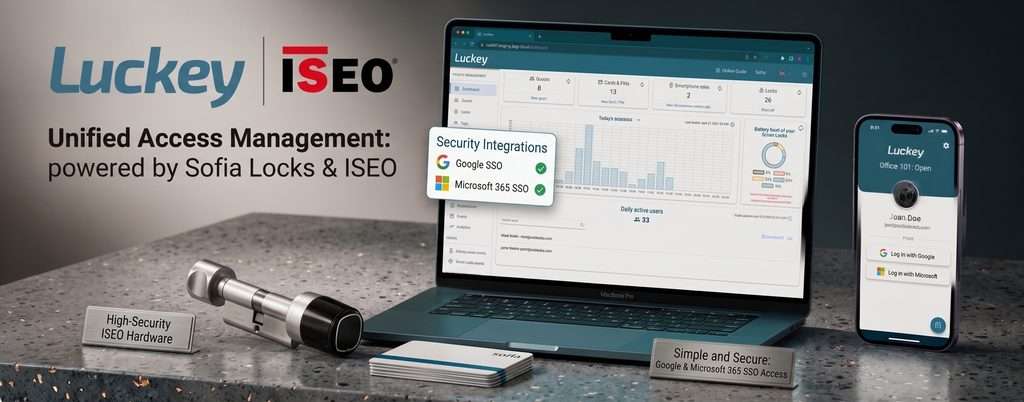
Identity is the starting point. Luckey integrates natively with Microsoft 365 and Google Workspace, so employees sign in with the corporate account they already use, under the authentication policies the organisation has already defined. With Microsoft 365 the connection goes further than login: through the Resources and Reservations add-on, a room invited into an Outlook meeting generates the corresponding booking and the associated access right automatically. For organisations standardised on other identity providers, the platform also supports SAML 2.0, Auth0 and Google SSO.
The employee lifecycle drives access rights. Integrations with HR and time-attendance platforms such as Fluida and Peoplelink synchronise users automatically and map them to the right access groups based on their role. When someone joins, changes team or leaves, physical access follows without anyone opening a spreadsheet. The HR system becomes the single source of truth, and one of the most persistent security gaps in any organisation — the ex-employee whose badge still works — simply closes.
And it connects to the rest of the building stack. Booking platforms like FarBooking, video management through Eagle Eye Networks, and mobile credential technologies such as HID Mobile Access via BLE all plug into the same platform. Beyond the catalogue, open APIs mean the integrator can connect whatever else the customer already runs.
This is the part that matters commercially. An ICT partner is not being asked to learn a new discipline — they are being asked to apply the one they already have. Identity, provisioning, SSO, API integration: it is the same work they do every day, applied to doors.
The Competitive Advantage for IT Partners
Across Europe, the IT channel is proving to be one of the fastest-growing routes to market for cloud access control. The business model fits naturally into how IT partners already work:
- Higher-value proposition: PropTech SaaS is a specialized product that rewards applications skills, with a value profile structurally different from the resale of commodity IT hardware.
- Marginal customer acquisition cost: VARs can bring the offer to a customer base they already serve and already have the trust of.
- Recurring revenue (SaaS): the subscription model fits the billing logic IT partners have already built.
- Deeper customer relationship: by supporting both digital identity and physical access, the IT partner becomes a reference point on a broader portion of the customer’s infrastructure — which translates into stronger retention.
Designed for Enterprise IT Governance
A Digital Workplace platform handles personal data, and IT Managers rightly evaluate it on those terms. Access, booking, and visitor data must be managed under GDPR principles, with clear retention policies and role-based access to information. In Italy, any processing that could enable remote monitoring of employees also falls under Article 4 of the Workers’ Statute, which requires a union agreement or authorization from the Labour Inspectorate. Addressing this early is not an obstacle to the project — it is one of the areas where a competent IT partner adds the most value.
An Expanding Ecosystem
This evolution toward the IT channel does not replace the essential work of our historical partners, the traditional locksmiths and security installers. The two worlds are complementary. Their expertise in physical security, door hardware, and safety compliance remains irreplaceable, and it becomes more valuable — not less — as buildings become more connected. What is changing is that a second conversation is now happening in parallel, inside the IT department, and the projects that go best are the ones where both competencies are at the table.